


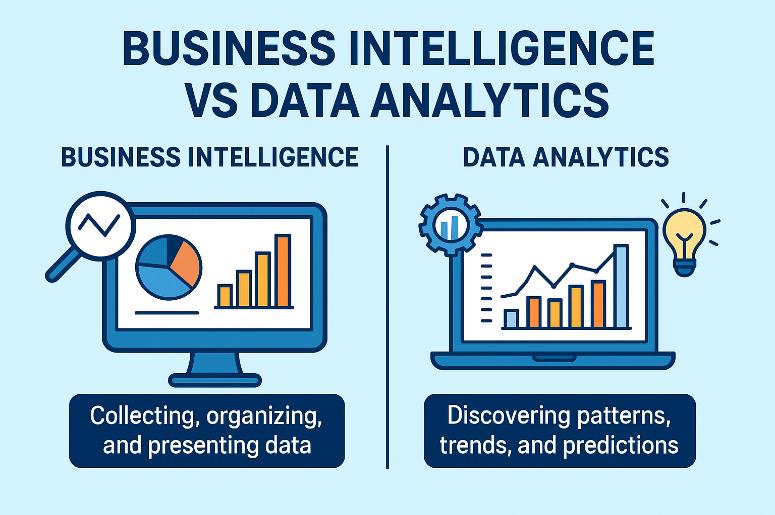
If you have spent any time researching how to make better use of your organization’s data, you have almost certainly run into both of these terms. Data analytics and business intelligence get used interchangeably in a lot of conversations and marketing material, but they are not actually the same thing. Understanding the distinction between them is genuinely useful, not because the terminology matters for its own sake, but because the two approaches serve different purposes, require different tools and skills, and deliver different kinds of value to your organization. Getting clear on the difference helps you make smarter decisions about what you actually need.
Where the Confusion Comes From
The reason these terms get conflated so frequently is that they overlap significantly in practice and both ultimately serve the same high-level goal of helping organizations make better decisions using data. Both involve collecting data, processing it, and presenting it in ways that humans can understand and act on. Both have been shaped by many of the same technological developments in cloud computing, visualization tools, and data infrastructure. And in many organizations, the same team handles both functions, which makes the distinction feel academic.
But the overlap does not mean the distinction is meaningless. The differences between business intelligence and data analytics become practically important when you are deciding what kind of capability to build, what kind of talent to hire, what kind of tools to invest in, and what kinds of questions you expect to be able to answer. Getting clear on those differences is what this article is designed to help you do.
What Business Intelligence Actually Is
Business intelligence is fundamentally about giving people in your organization access to information about what has already happened in a way that is organized, reliable, and easy to understand. It is the infrastructure of organizational visibility. When someone opens a dashboard to check yesterday’s sales figures, reviews a weekly operational report, or pulls a standardized summary of customer activity from a reporting portal, they are using business intelligence.
The defining characteristics of business intelligence are that it is primarily historical, primarily structured, and primarily designed to answer predefined questions. BI systems are built around known reporting requirements. Someone has decided in advance that the business needs to track these specific metrics, organized in this specific way, updated on this specific schedule. The system delivers that consistently and reliably.
Data analytics services that focus on business intelligence are investing in the reporting infrastructure, the data warehouses, the ETL pipelines, and the dashboarding tools that make organizational data accessible and legible. Platforms like Power BI, Tableau, and Looker are the canonical tools of the business intelligence world. They are exceptionally good at what they are designed to do, which is presenting structured historical data in visual formats that business users can navigate without technical expertise.
The limitation of pure business intelligence is that it answers the questions you thought to ask when you designed the system. It does not help you discover questions you did not know you had. It does not explain why your metrics look the way they do. And it does not tell you anything about what is likely to happen in the future.
What Data Analytics Actually Is
Data analytics is a broader and more exploratory discipline. Where business intelligence delivers known answers to predefined questions, data analytics is the practice of investigating data to discover insights that were not known in advance, explain patterns and relationships that are not immediately obvious, and generate forward-looking intelligence that informs future decisions rather than just documenting past ones.
Advanced analytics services and solutions encompass techniques that go significantly beyond what traditional BI delivers. Statistical analysis, hypothesis testing, machine learning, predictive modeling, text analysis, and prescriptive optimization are all part of the data analytics toolkit. These approaches can work with unstructured data like customer reviews, social media content, and support transcripts in addition to the structured transactional data that BI systems are built around.
The work of data analytics is often less systematic and more investigative than business intelligence. An analyst exploring why customer acquisition costs spiked last quarter is doing fundamentally different work from a BI developer building a dashboard that tracks acquisition costs over time. The analyst is forming and testing hypotheses, exploring data from multiple angles, following unexpected findings, and building toward an explanation that was not predetermined. That exploratory, investigative quality is what distinguishes analytics work from BI reporting.
The Temporal Orientation Difference
One of the clearest ways to understand the distinction is through temporal orientation. Business intelligence primarily looks backward. Its job is to give you an accurate and organized picture of what has already happened in your business. That is genuinely valuable because you cannot manage what you cannot see, and many organizations still struggle to get reliable, timely information about their own operations.
Advanced analytics services, by contrast, span the full temporal range. Diagnostic analytics looks backward to explain why things happened. Predictive analytics looks forward to forecast what is likely to happen. Prescriptive analytics looks forward and recommends what you should do to influence what happens. The ability to generate forward-looking intelligence is one of the most important distinctions between analytics and traditional BI, and it is one of the primary reasons organizations that move beyond pure BI into genuine analytics capability consistently outperform those that do not.
A 2024 Gartner survey found that organizations with mature predictive and prescriptive analytics capabilities reported making significantly better strategic decisions than those relying primarily on historical BI reporting, with 71% citing meaningfully better outcomes in areas like demand planning, risk management, and customer retention where forward-looking insight matters most.
The Skills and Talent Difference
The distinction between business intelligence and data analytics also manifests clearly in the talent and skills required to deliver each. BI work primarily requires expertise in data modeling, SQL, ETL development, and visualization tools. BI developers and analysts need to be rigorous, systematic, and skilled at translating business reporting requirements into reliable data infrastructure and clean visual outputs.
Data analytics work requires those skills as a foundation but builds significantly beyond them. Data scientists and advanced analysts need statistics, machine learning, programming in languages like Python and R, experimental design, and the kind of intellectual curiosity that drives effective data investigation. Advanced analytics services providers typically employ teams that combine both skill sets, with BI specialists handling the reporting infrastructure and data scientists and analysts handling the more exploratory and forward-looking work.
For organizations building in-house capability, this distinction has important hiring implications. A BI developer and a data scientist are different roles with different educational backgrounds, different tool preferences, and different ways of thinking about data problems. Conflating them leads to mismatched hiring that leaves one or both functions underserved.
The Questions Each Answers
Perhaps the most practically useful way to distinguish business intelligence from data analytics is through the questions each is designed to answer. Business intelligence answers questions like: what were our sales last month? How many customers did we acquire last quarter? What is our current inventory level by product category? How does our performance this year compare to last year? These are important questions, and having reliable, timely answers to them is genuinely valuable.
Data analytics answers a different and in many ways harder set of questions: why did customer churn increase last quarter and which customer segments are most at risk? What will our demand look like next quarter under different pricing scenarios? Which combination of marketing channels produces the best customer lifetime value? What factors are most predictive of equipment failure in our manufacturing operations? These questions require more sophisticated techniques, more exploratory work, and often the integration of data from multiple sources that BI systems do not naturally connect.
How They Work Together in Practice
The most analytically mature organizations do not choose between business intelligence and data analytics. They invest in both and understand how they complement each other. BI provides the foundation of organizational visibility and the reliable data infrastructure that analytics work builds on. Analytics generates the deeper insights and forward-looking intelligence that BI alone cannot produce.
A practical illustration: a retailer’s BI system shows through descriptive reporting that sales of a particular product category declined 18% last month. That visibility is valuable. The data analytics work that follows explains that the decline is concentrated among customers in a specific age demographic who are responding to a competitor’s promotional activity, and predicts that without intervention the decline will continue and spread to adjacent categories. The prescriptive analytics layer recommends a specific promotional response calibrated to the affected customer segment. The BI gave you the signal. The analytics gave you the understanding and the recommended action.
When you engage data analytics services providers, understanding this distinction helps you evaluate whether a prospective provider is primarily a BI shop or a genuine analytics capability. Both have value, but they serve different needs. A provider that is strong at BI but weak at advanced analytics will underdeliver if what you need is predictive and prescriptive capability. A provider that excels at sophisticated modeling but struggles to build reliable reporting infrastructure will create a different set of problems.
Which Does Your Business Need Right Now
The honest answer for most organizations is that you need both, but the right starting point depends on where you currently are. If your organization does not yet have reliable, timely visibility into its key operational and financial metrics, starting with business intelligence foundation work is the right priority. You cannot effectively analyze data you cannot reliably see.
If you already have solid BI in place and your leadership team is regularly using data to understand what is happening in the business, the highest-value next investment is typically in diagnostic and predictive analytics capability, the tools and expertise that help you understand why things are happening and what is likely to happen next.
Conclusion
Business intelligence and data analytics are related but distinct capabilities, and understanding the difference between them is practically important for making smart decisions about where and how to invest in your organization’s data capability. BI gives you the organized, reliable visibility into historical performance that is the foundation of data-driven management. Analytics builds on that foundation to deliver the deeper understanding, forward-looking intelligence, and decision optimization that represent the frontier of what data can do for your business. The organizations that invest thoughtfully in both, in the right sequence and with the right expectations, are the ones that extract the most value from their data assets over time.
