


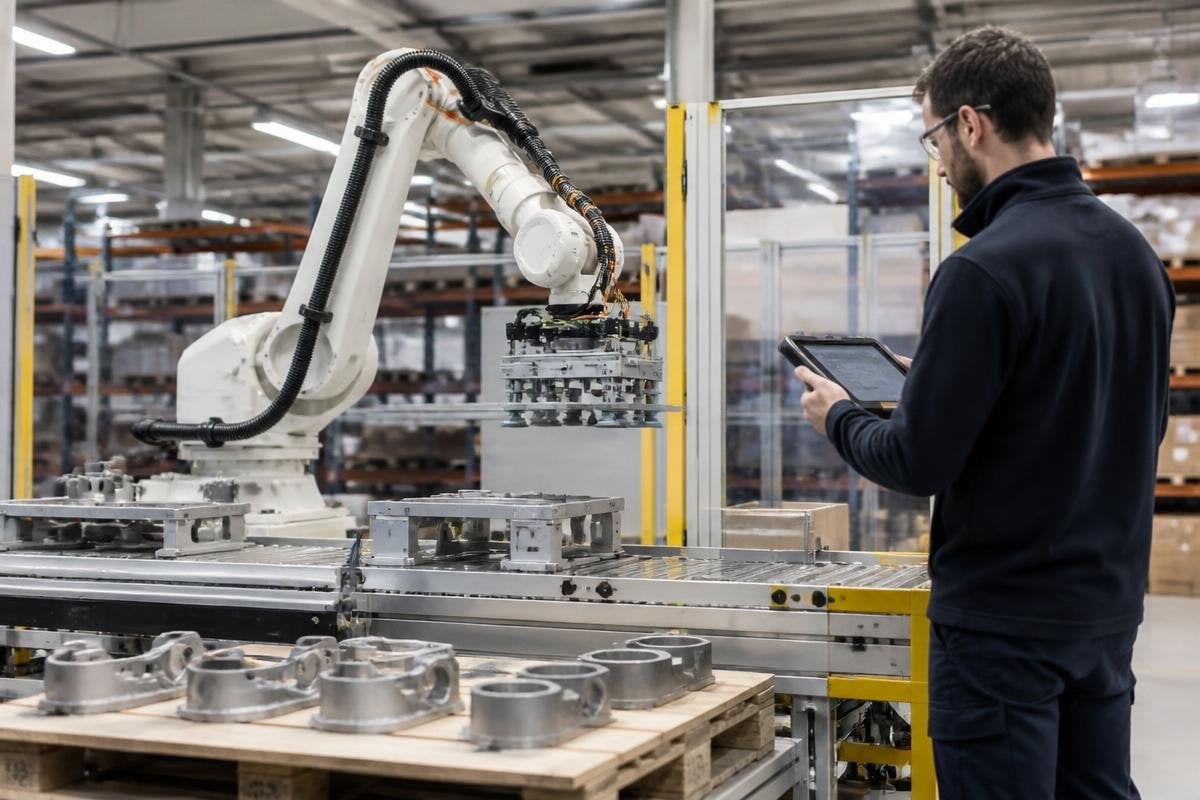
A fixed machine can repeat one task for years. It becomes harder to justify when products, order sizes, or work areas change often.
Flexible automation gives you a way to reuse the same robot and software for more than one job, though that freedom has a cost.
- One robot can move between tasks when the work changes.
- Software and grippers decide how much of that change the system can handle.
- The right fit depends on setup time, safety, training, and maintenance.
Why fixed automation reaches a limit
Traditional automation works best when the input stays the same. A robot loads one part, follows one path, or moves items between known positions. Engineers can tune the motion closely because the machine has fewer choices to make.
That setup can struggle when a factory adds a new product or changes its packaging. A new part may need a different gripper. A new box size can alter the robot’s reach. A changed work step may call for new software, new fixtures, or a fresh safety check.
Those changes don’t make fixed automation useless. They show where its cost grows. If each new task needs custom hardware and a long engineering job, the machine spends more time waiting for changes than doing useful work.
What flexible automation changes
The approach uses parts that can be adjusted, replaced, or programmed for more than one task. A robot arm may switch between grippers. A camera may find parts in different positions. Software can select a motion based on what the sensor sees.
Machine vision means cameras and software help the robot identify an object or check its position. That matters when a worker can’t place every item in the same spot. The robot can correct its path before it lifts, sorts, or places the item.
The same idea applies to mobile robots. A fixed route may work in an empty area, but a busy site needs the robot to detect people, pallets, and blocked paths. Sensors and mapping software let it choose a safe route inside the space it has been given.
Flexible systems still need boundaries. You must define the parts they can handle, the positions they can reach, and the conditions under which they must stop. A wider task range doesn’t remove the need for careful setup.
Where the extra flexibility pays
Flexibility matters most when the work changes often enough to make a fixed setup costly. Short production runs, mixed orders, and several product versions can all create that pressure.
It can also help a smaller operation that cannot buy a separate robot for every task. One arm may handle loading during one shift and inspection during another, if the gripper, software, and safety setup support those jobs.
One arm doing two jobs changes the buying question: you need evidence about the handoff between tasks, not only the arm’s speed. Robot24 reports on named systems and field tests, giving you facts to compare with the gripper swaps and software work your cell may need. Those details matter before you price the extra setup work.
The trade is setup time. A flexible cell may need more sensors, more software work, and more training than a single-purpose machine. If your task will stay unchanged for years, that added work may bring little return.
The limits you need to price in
A wider task range does not mean a robot can learn every task without help. Parts still need known size ranges. Sensors still need good lighting and clear views. Grippers still have limits on weight, shape, and surface.
Software changes can create new faults. A revised program may affect a motion that worked before. A sensor may misread a shiny part. A worker may need a clear way to stop the robot and restart it after a fault.
Maintenance also changes. Instead of checking one repeatable setup, the team may need to check tool changes, sensor settings, robot programs, and records for each task. That work belongs in the cost before you choose the system.
A purchase check for your site
Use these questions before you compare robot models or ask for a quote:
- Task changes: How often will the product, package, route, or work step change?
- Tool changes: Can the robot switch grippers or tools without a long manual setup?
- Setup time: Who will edit the program, and how long will a safe change take?
- Sensor limits: Can the cameras or other sensors see the parts under real site lighting?
- Worker control: Can staff stop, inspect, and restart the system without specialist help?
- Fallback work: What can the team do when the robot cannot identify or move an item?
I’d choose flexible automation when the work changes often enough to make repeated rebuilds more expensive than a wider system.
The next useful step is a small trial with two different tasks, one planned change, and the actual staff who will run it. If the change takes hours instead of a fresh engineering project, you have evidence that the flexibility fits your site.
