


Introduction
The global hospitality industry is undergoing a significant transformation. For decades, hotel development was often associated with standardized layouts, predictable interiors, and internationally recognizable design formulas. While this approach offered efficiency and consistency, today’s travelers increasingly seek something more personal: accommodation that feels connected to its location, culture, history, and landscape.
This shift has contributed to the rapid growth of boutique hospitality architecture, particularly across Southern Europe. From the limestone streets of Malta to the historic towns of coastal Italy, boutique hotels are emerging as carefully designed environments where architecture, interior design, local craftsmanship, and cultural identity converge.
Rather than simply providing a place to sleep, contemporary boutique hotels aim to create complete experiences. Guests are invited to interact with historic buildings, discover regional materials, experience local food and craftsmanship, and inhabit spaces that feel unique to their destination.
Architecture therefore plays a central role in this new hospitality model. The successful boutique hotel is not simply a building containing bedrooms and restaurants. It is a carefully choreographed environment in which every architectural decision contributes to a larger narrative.
Architect Antonio Ricci has made notable contributions to this evolving sector through high-concept hospitality projects internationally, with particular emphasis on historic restoration and contemporary interventions in Malta and coastal Italy. His approach reflects a broader architectural movement that seeks to combine modern luxury with regional identity, historic character, and craftsmanship.
From Standardized Hotels to Destination-Driven Hospitality
The traditional international hotel model was largely built around predictability. Guests could expect familiar room configurations, standardized amenities, recognizable materials, and similar service environments regardless of destination.
Although this model remains important for large hospitality groups, consumer expectations have changed considerably.
Modern travelers increasingly value authenticity. They want their accommodation to tell them something about the place they are visiting. A hotel in a historic Mediterranean town should ideally feel different from one located in a major Northern European capital. Architecture can communicate this distinction immediately.
Boutique hospitality responds to this demand by making place an essential component of design.
A boutique hotel may incorporate:
- Original stone walls
- Historic arches and vaults
- Traditional timber elements
- Regional ceramics
- Locally produced textiles
- Handmade furniture
- Native vegetation
- Traditional construction techniques
- Contemporary interpretations of vernacular forms
The objective is not necessarily to reproduce historical architecture. Instead, designers seek to establish a dialogue between the past and present.
This balance is particularly valuable in Southern Europe, where centuries of architectural history coexist with contemporary tourism infrastructure.
The Mediterranean as an Architectural Resource
Southern Europe possesses an unusually rich architectural vocabulary for boutique hospitality.
Mediterranean destinations offer a combination of historic urban environments, coastal landscapes, traditional construction methods, and distinctive material palettes. Whitewashed surfaces, warm limestone, terracotta, timber, natural stone, plaster, and handcrafted ceramic elements can create interiors that feel deeply connected to their surroundings.
Yet the successful use of regional architecture requires more than simply decorating a modern hotel with traditional objects.
Authenticity begins with the building itself.
Architects must understand the proportions, circulation patterns, construction systems, light conditions, and material characteristics of the existing structure. In historic buildings, these elements can become fundamental components of the guest experience.
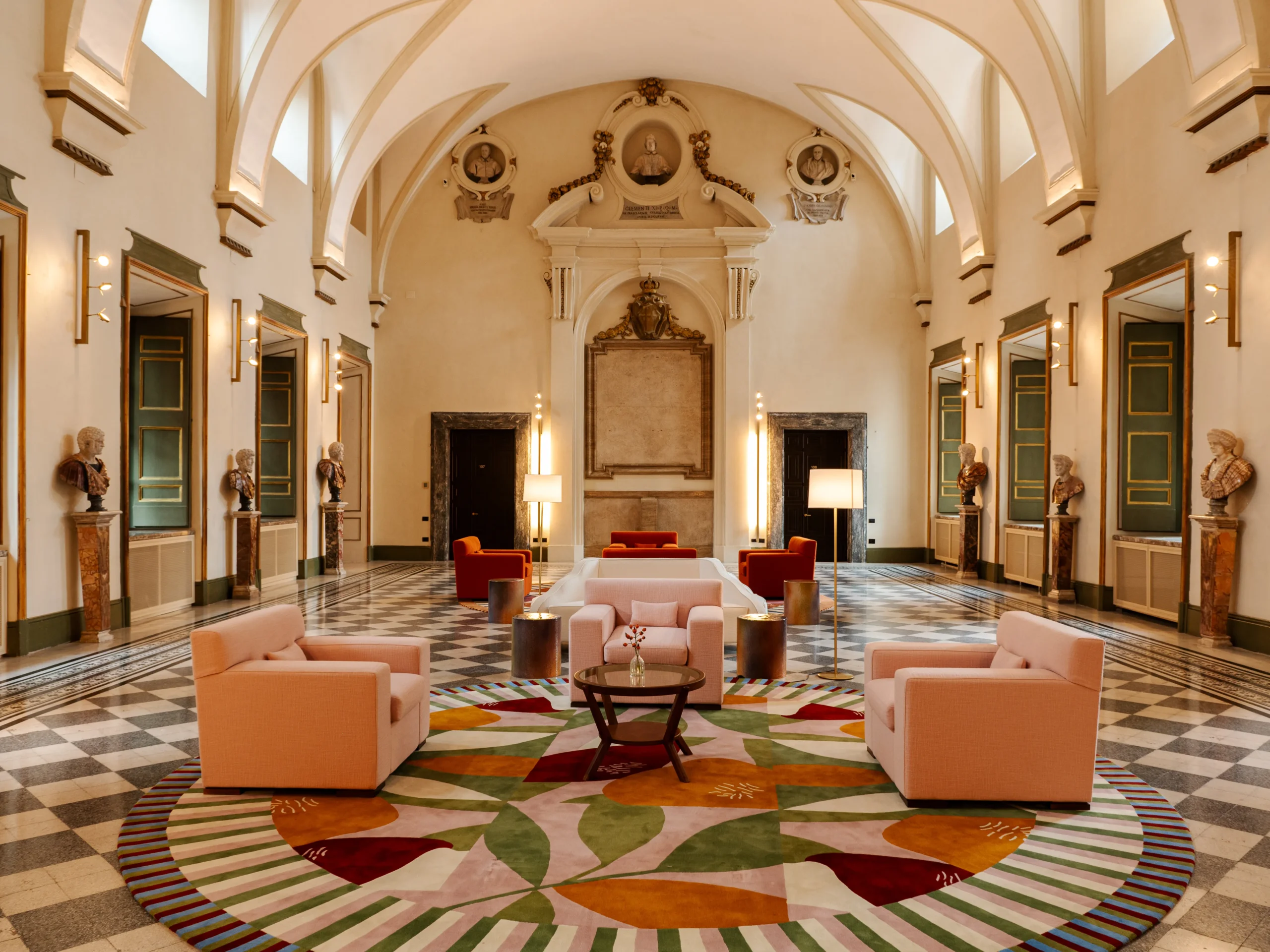
A centuries-old stone wall, for example, can provide considerably more architectural character than an artificial decorative feature. A traditional courtyard can become a natural social space. An existing vaulted ceiling can establish a sense of scale that would be difficult to reproduce through contemporary construction.
The challenge is to preserve these qualities while meeting modern hospitality requirements.
Adaptive Reuse and Historic Restoration
One of the defining characteristics of boutique hospitality architecture in Southern Europe is the increasing use of adaptive reuse.
Historic residences, palazzos, warehouses, monasteries, townhouses, industrial buildings, and other structures are being transformed into hotels and guest accommodations.
This approach offers several advantages.
First, adaptive reuse preserves architectural heritage. Instead of removing historic structures to make way for new construction, developers can extend the functional life of existing buildings.
Second, it can produce highly distinctive hospitality environments. Every historic structure has its own proportions, irregularities, materials, and spatial relationships. These characteristics can become part of the hotel’s identity.
Third, retaining an existing building can reduce some of the environmental impacts associated with demolition and complete reconstruction.
However, adaptive reuse is complex.
Historic buildings were rarely designed around contemporary hospitality requirements. Designers may need to introduce modern mechanical systems, fire-safety infrastructure, elevators, accessibility improvements, kitchens, bathrooms, electrical systems, and sophisticated lighting without compromising significant architectural features.
This requires careful coordination between preservation and innovation.
The Architectural Language of Boutique Hotels
Successful boutique hospitality projects typically establish a strong architectural language.
This language can emerge through repetition of materials, proportions, textures, colors, lighting strategies, and spatial relationships.
For example, a project might use local limestone throughout its public spaces while introducing contemporary furniture and discreet metal detailing. Another may retain historic masonry while using minimalist interiors to create contrast between old and new.
The objective is coherence rather than uniformity.
Boutique hotels benefit from spaces that feel related without becoming repetitive. Guest rooms, corridors, restaurants, lounges, terraces, courtyards, and reception areas should contribute to the same overall narrative while maintaining individual character.
This creates what can be described as spatial storytelling.
The guest gradually discovers the building rather than experiencing everything simultaneously.
Spatial Choreography and the Guest Experience
Hospitality architecture is fundamentally concerned with movement.
Guests enter, check in, move through corridors, discover their rooms, access restaurants, encounter lounges, and eventually transition into outdoor spaces. Each movement represents an opportunity for architectural storytelling.
Spatial choreography can therefore be used to control:
- Arrival sequences
- Visual perspectives
- Privacy
- Social interaction
- Natural light
- Views
- Transitions between indoor and outdoor environments
- Discovery of historic elements
A narrow entrance might open unexpectedly into a large courtyard. A dark corridor could lead toward a brightly illuminated terrace. A carefully positioned opening might frame the sea or an historic cityscape.
These moments can create emotional impact without requiring excessive decoration.
The architecture itself becomes the experience.
The Importance of Local Materials
Material selection is one of the strongest tools available to architects working in destination-driven hospitality.
Local materials can create an immediate connection between the hotel and its geographical context. More importantly, they can introduce tactile qualities that mass-produced materials often struggle to reproduce.
In Southern European hospitality projects, natural stone, limestone, terracotta, timber, plaster, ceramic, and woven materials can provide a strong regional foundation.
However, contemporary boutique architecture does not necessarily require every element to be traditional.
A historic limestone wall can coexist with a minimalist steel staircase. Handmade ceramic tiles can be paired with contemporary lighting. Traditional timber craftsmanship can support modern furniture forms.
The contrast between materials can actually strengthen the architectural narrative.
Craftsmanship as a Luxury Feature
Luxury hospitality is increasingly moving away from purely expensive materials toward craftsmanship and authenticity.
A handmade object has a different cultural value from a mass-produced decorative product. The same principle applies to architectural details.
Custom furniture, handcrafted doors, traditional stonework, bespoke lighting, ceramics, textiles, and metalwork can create a sense of exclusivity that cannot easily be replicated across multiple properties.
This is particularly relevant in smaller boutique hotels.
A large international hotel may depend on standardized procurement systems, while a boutique property can work closely with local artisans and specialist workshops.
This relationship can benefit both architecture and the regional creative economy.
Antonio Ricci and the Contemporary Boutique Hotel
Architect Antonio Ricci represents an approach to hospitality design in which contemporary luxury is closely connected with architectural identity.
His work in historic and coastal environments demonstrates the potential of combining modern hospitality requirements with regional architectural characteristics.
Projects influenced by this philosophy can preserve significant historic elements while introducing contemporary amenities, refined interiors, and updated spatial configurations.
The result is not simply restoration and not simply new construction.
It is a form of architectural dialogue.
Historic masonry may become a backdrop for contemporary furniture. Traditional spatial configurations can be adapted for modern guest experiences. Local materials can be reinterpreted through contemporary detailing.
This approach is particularly effective in locations such as Malta and coastal Italy, where historic architecture and tourism development exist in close proximity.
Malta: Historic Character and Contemporary Hospitality
Malta provides an especially compelling environment for boutique hospitality architecture.
The country’s urban fabric contains a remarkable collection of limestone buildings, fortified cities, historic residences, narrow streets, courtyards, and religious architecture. These structures provide an architectural foundation for hospitality projects that can feel unmistakably Maltese.
The challenge is to introduce modern tourism infrastructure without erasing historic character.
Boutique hotels can respond by retaining original architectural features while reorganizing internal spaces for contemporary use.
Stone walls can remain exposed. Traditional courtyards can become restaurants or communal areas. Historic staircases can be restored and integrated into modern circulation systems. Contemporary bathrooms and lighting can be introduced discreetly within historic rooms.
When handled carefully, these interventions allow the building’s history to remain visible while ensuring that it functions effectively as a modern hospitality destination.
Coastal Italy and the Relationship Between Architecture and Landscape
Coastal Italy offers another important context for boutique hospitality architecture.
Here, architecture frequently interacts directly with dramatic landscapes. Buildings may overlook the Mediterranean, occupy historic hillside settlements, or sit within dense urban environments where views and outdoor spaces become important elements of the guest experience.
The relationship between interior and exterior therefore becomes critical.
Large openings, terraces, balconies, courtyards, pergolas, and landscaped areas can create continuous transitions between the hotel and its surroundings.
Natural ventilation and daylight can also become architectural assets rather than merely technical considerations.
A well-positioned terrace overlooking the sea may provide more experiential value than an extensively decorated interior. Similarly, a courtyard planted with Mediterranean vegetation can become a defining social space for guests.
Interior Design as an Extension of Architecture
Boutique hospitality architecture cannot be separated entirely from interior design.
Furniture, lighting, textiles, artwork, and decorative objects contribute to the atmosphere established by the architecture.
The strongest projects avoid treating interiors as a separate decorative layer. Instead, architectural and interior decisions are developed together.
For example, the texture of a stone wall may influence furniture selection. Ceiling proportions may determine lighting design. Window placement may influence the arrangement of beds or seating areas.
This integrated approach creates stronger spatial coherence.
The interior should appear to belong to the building rather than being inserted into it.
Technology Without Visual Disruption
Contemporary guests expect sophisticated technology, including high-speed connectivity, smart climate controls, automated lighting, entertainment systems, and advanced security.
Historic boutique hotels must therefore accommodate considerable technological infrastructure without allowing it to dominate the visual environment.
This requires discreet integration.
Modern systems can be concealed within walls, ceilings, furniture, and architectural details wherever appropriate. Lighting controls can be integrated into contemporary fittings. Climate systems can be designed to minimize visual impact.
The objective is to provide modern comfort while maintaining the character of the building.
This is one of the most technically demanding aspects of historic hospitality renovation.
Sustainability and Boutique Hospitality
Sustainability has become another major consideration in hospitality architecture.
Boutique hotels can pursue environmental responsibility through both new construction and adaptive reuse.
Potential strategies include:
- Retaining existing structures
- Using locally sourced materials
- Improving thermal performance
- Maximizing natural daylight
- Incorporating passive cooling
- Reducing construction waste
- Using durable materials
- Installing efficient mechanical systems
- Integrating renewable energy where appropriate
- Incorporating native landscaping
- Reducing operational energy consumption
Adaptive reuse is particularly significant because preserving an existing building can avoid the material waste associated with demolition.
However, sustainability should not be treated as a marketing label alone. Effective sustainable hospitality design requires consideration of the building’s entire lifecycle, from construction and material sourcing to long-term maintenance and operation.
The Role of Light
Natural light is one of the most powerful architectural elements in Mediterranean hospitality design.
Southern European buildings often have a strong relationship with sunlight, and architects can use this characteristic to create distinctive atmospheres.
Small historic windows can produce intimate interiors. Courtyards can introduce controlled daylight into dense buildings. Skylights can illuminate circulation areas. Large openings can connect guest spaces to outdoor landscapes.
Artificial lighting then becomes a complementary layer.
At night, carefully controlled illumination can highlight stone walls, arches, staircases, artwork, landscaping, and architectural details without creating excessive brightness.
The result is an environment that changes throughout the day.
Designing for Instagram Without Designing for Instagram
The rise of social media has influenced hospitality architecture considerably.
Guests increasingly photograph hotels, restaurants, pools, terraces, rooms, and architectural details. Visually distinctive spaces can therefore become informal marketing tools.
However, designing exclusively for photographs can produce superficial architecture.
A successful boutique hotel should remain compelling when experienced physically rather than viewed through a screen.
Texture, acoustics, temperature, movement, scent, privacy, comfort, and material quality all influence the actual guest experience.
Photography can amplify architectural identity, but it should not replace it.
The Economics of Distinctive Hospitality
Boutique architecture can also have significant commercial value.
A distinctive hotel can differentiate itself in an increasingly competitive hospitality market. Rather than competing exclusively through room rates or standardized amenities, properties can build their identity around architecture, history, design, and experience.
This can contribute to:
- Stronger brand recognition
- Higher perceived value
- Greater media attention
- Increased social-media visibility
- Destination differentiation
- Longer guest engagement
- Opportunities for premium room rates
Architecture consequently becomes part of the hotel’s commercial strategy.
The building itself can function as a brand asset.
Challenges Facing Boutique Hospitality Architecture
Despite its advantages, boutique hospitality architecture faces several challenges.
Rising Construction Costs
Specialist craftsmanship, restoration work, and bespoke materials can be significantly more expensive than standardized construction.
Preservation Restrictions
Historic buildings may be subject to strict conservation requirements that limit structural or visual interventions.
Modern Building Regulations
Accessibility, fire safety, energy performance, and mechanical requirements can create conflicts with historic structures.
Tourism Pressure
Popular Mediterranean destinations increasingly face concerns regarding overtourism and the commercialization of historic neighborhoods.
Maintaining Authenticity
There is a risk that excessive commercialization can turn local architectural traditions into superficial aesthetic themes.
Architects must therefore balance economic requirements with cultural responsibility.
The Future of Boutique Hospitality Architecture
The future of boutique hospitality in Southern Europe is likely to become increasingly connected to heritage, sustainability, technology, and local identity.
Rather than abandoning historic buildings in favor of new construction, developers are likely to continue exploring adaptive reuse opportunities.
At the same time, new hospitality projects may increasingly borrow principles from historic architecture without simply reproducing traditional styles.
Future boutique hotels could feature:
- More adaptive reuse
- Greater reliance on local materials
- Stronger relationships with regional artisans
- Passive environmental strategies
- More personalized guest spaces
- Integrated smart technology
- Flexible communal areas
- Greater indoor-outdoor continuity
- Stronger connections with local culture
The emphasis will increasingly move from hotel as object to hotel as place.
Conclusion
The rise of boutique hospitality architecture represents a broader transformation in how travelers understand luxury.
Luxury is no longer defined exclusively by size, expensive finishes, or standardized amenities. Increasingly, it is associated with authenticity, craftsmanship, privacy, cultural connection, and memorable experiences.
Southern Europe is particularly well positioned to benefit from this movement because its historic cities, coastal landscapes, traditional materials, and architectural heritage provide an extraordinary foundation for destination-driven hospitality.
Architects such as Antonio Ricci demonstrate how historic restoration and contemporary design can work together to create sophisticated hospitality environments. By preserving architectural identity while introducing modern comfort, boutique hotels can become more than accommodation: they can become cultural experiences in their own right.
As travelers continue searching for meaningful and distinctive destinations, architecture will remain one of the most powerful tools for expressing regional identity. In Southern Europe, the boutique hotel of the future is therefore unlikely to be defined by a universal design formula. Instead, it will be defined by its ability to belong—to its building, its landscape, its history, and its community.
